16 November 2024

More welcome notes from Tony Thomas

BIB editor's note: Thanks again to banjo historian Tony Thomas for his additional notes below on the 2020 BIB post 'Alan Lomax, the banjo, and bluegrass (CORRECTION):'

Just want to underline my comments about Stu are based on not only my extensive research, but on the last years of Stu's life in the 2000s. I knew Stu when he moved to Florida. He was increasingly restricted by his final illness for years, but I had hours and hours of telephone conversations with Stu over the last several years of his life about banjo issues, especially about Gribble, Lusk and York, and more recently I have been working with the Gribble Lusk and York website. I just returned from the US old-time festival Fiddle Hell, where I played banjo representing Murph Gribble's style in two workshops, one on Gribble Lusk and York tunes to be played in G tuning and on tunes that can be played in D.

Labels: , ,

18 September 2024

A posthumous honour for the BIB

The BIB editor writes:

Exactly a year after my retirement as editor, the BIB reopens in order to make public a welcome and important contribution from Tony Thomas, a leading scholar of banjo history; one of his works is cited below.

The contribution arrived in the form of a series of comments on the BIB post Alan Lomax, the banjo, and bluegrass (CORRECTION) of 14/18 Aug. 2020, which mentioned the Black banjo-player Murphy Gribble and the white folklorist and banjo-player Stu Jamieson. Mr Thomas's contribution follows:


First, Stu's views should be primary since Stu is the one who found Murph Gribble by asking his grand aunt in Champion Tennessee who had the best string band in their area in 1946. It is Stu along with Margret Mayo who recorded the band in 1946 and who returned several years later to record the band, and to record Gribble playing not only as a band, but to record Gribble playing solo, using Stu's Fairbanks banjo. Stu was familiar with the style of playing because his grandfather, a person Stu idolized in all things had played the banjo in this style. In the last years of his life I spent hours talking with Stu about this. What Stu noted was the similarities in the propulsive attack of the whole band of which Gribble was the leader.

At the same time all the other sourcing especially my friend Bob Carlin's work is important on this subject. Others I know who have discussed influences with Earl found that Earl said early, being someone born in 24 and a teenager in the 1930s and early 40s talked about doing on the banjo things he heard Charlie Christian do on Benny Goodman records, and also very strong influence like everyone with ears in North Carolina in the late 30s and 1940s, to try to do things that Blind Boy Fuller was doing on guitar on the banjo, and a bunch of other influences. To be sure the Gribble Lusk band had a drive and was banjo-driven with Gribble as the leader deciding to lead the band from banjo (he was reputed to be a great fiddler fron an early age and had become more or less of a professional musician due to limitations in his physical capacities due to being injured in the Great War).

Looking at this band and Gribble's banjo only in a narrow and uninformed view of its similarities to bluegrass reflects not looking at it in relation to Black music which surrounded it, or its crucial role as essentially the only viable Black string band ever recorded while it was still a vernacular band performing for audiences and money, Stu told me that a big problem was when he received permission to use the town general store to record them the first time, the store was packed with with white people who wanted to hear the band under Jim Crow even the band was afraid to go there and perform and Stu's aunt or grand aunt who suggested the place and lived locally received disrespect from local white folk for years for Stu and Margret's treatment of the band members with equality calling them Mr. Gribble and Mr. Lusk and that Stu gave them a ride home about 10 miles in his car rather than letting them walk in the night.

These recordings are really more important than their limited relationship to bluegrass, but of the survival of a significant Black string band tradition. Also quite meaningful is Gribble's three or possible four-finger banjo style, rather than frailing and two-finger picking. We have found that this banjo style was widely used by African American musicians, most notably Gus Cannon all whose 1930s recordings were in this style and who taught anyone who approached him for banjo lessons this style correctly called the guitar style of banjo, Cannon teaching and using all 4 finger as SS Stewart would have taught. There are many other examples of Black guitar-style banjoists, some of international repute, and at least one still getting still able to get encores at the Apollo Theater in NYC in the 1940s. Again this was the preferred popular and parlor approach to the banjo played across the English speaking world, played by Edward VII and his successor as his mother, well known as a banjo fan since the days of Sweeney, had sent both future monarchs and their sister [See comment below - BIB editor] to take banjo lessons with the Bohees. A colleague from Sweden decades ago found the receipts for the lessons in Palace records.

The limits of this interchange reflect the limitations and stereotypes of knowledge about African American and world banjo playing as well as what would have been in the air both for Earl Scruggs and Murph Gribble (he preferred "Murph" to Murphy) in their times in music. Consult my essay "The colored champion banjo pugilist of the world and the big world of the banjo", a chapter in University of Illinois Press’s prize-winning anthology Banjo roots and branches, published in 2018.

It is a bit bizarre that Stu's views and reporting is not put at the center. Stu found the band by asking his grand aunt what was the main local band where she lived. Stu recorded the band and witnessed their playing. Stu returned in 1948 or 49 to the area and was able to invite the band members to his grand aunt's house to record them again under better circumstances with Gribble actually playing Stu's very high quality banjo. Stu was a banjoist, and immediately identified the banjo approach Gribble used as his grandfather played banjo in the guitar-style like Gribble. Stu was prone to some exaggeration, but he was right on the beam on what Gribble was doing as well as some of the similarity to the Scruggs style which had become popular by time Stu wrote his invaluable field notes. Our knowledge of the banjo playing really starts with what Stu left us.

Labels: , ,

24 March 2023

Things to come, from the BGS

The latest Bluegrass Situation (BGS) Weekly Dispatch includes:

* Justin Hiltner's major interview with master fiddler Michael Cleveland, focusing on his latest album (Lovin' of the game, released on Compass Records earlier this month) and his ability to reach out beyond the bluegrass audience. The article includes five videos of tracks from the album (including a vocal version of the 'Temperance reel'), and quotes Cleveland: 'Any time I’ve been in a situation [...] where bluegrass is presented to an audience that isn’t familiar with it, it’s great. That’s what I like to do more than anything these days.'
* A feature on Alison Russell (on 5-string banjo) and members of the Black Opry performing 'You're not alone', which can also be seen on YouTube.
* A 52-minute podcast with Sara Watkins of the recently reunited Nickel Creek.
* A separate feature on Michael Cleveland, with a video (also on YouTube) of him, Flamekeeper, and Charlie Starr playing 'One horse town'.
* A mixtape compiled by Doug Paisley of the music of artists he encountered at the 1994 Merle Watson Memorial Festival. He comments: 'I like that bluegrass means such different things to its adherents, but that they all feel it strongly. It can be an exercise in authenticity, an article of faith, a technical jungle gym, and an emblem of a time and place in history. It’s a genre that’s small and quirky enough that some people feel they can inhabit, protect, and partly own it.'

No Depression has put online a long excerpt from the interview feature on Nickel Creek that is published in their spring print issue - Stacy Chandler's 'Nickel Creek meets in the middle for "Celebrants"'

© Richard Hawkins

Labels: , ,

02 February 2023

Valerie June and Marcela Avelar on Deering Live

Black History Month began yesterday, and singer, songwriter, and multi-instrumentalist Valerie June was featured on Deering Live on Tuesday this week, together with artist Marcela Avelar, who created the artwork for the children's book Somebody to love: the story of Valerie June's sweet little baby banjolele. The hour-long feature can also be seen on YouTube. The 5-string banjo is among the instruments Valerie June plays, and 'Drink up and go home'* is among the songs she performs.

*A recording by Jimmy Martin can be heard here.

© Richard Hawkins

Labels: , , ,

21 January 2023

Assorted goodies

Compass Records announce that 'For your love', the third single to be issued from the forthcoming album Lovin' of the game by master fiddler Michael Cleveland, is now available for streaming. The album is due for release on 3 Mar. 2023 and can be pre-ordered. See also John Lawless's feature on Bluegrass Today; you can hear there the new single, which has Billy Strings on guitar and lead vocals.
*
Michael Cleveland considers his new single 'a little bit of a departure' from his traditional bluegrass stance; on the other hand, the Kody Norris Show, who will be headliners at this year's Westport Folk and Bluegrass Festival, have just released on Rebel Records a new single and video, 'I call her sunshine', with a vigorously traditional sound. The video was premiered, and can be seen, on the Cowboys & Indians website, with banjo-player Josiah Tyree singing lead and fiddler Mary Rachel Nalley-Norris playing mandolin. More details are on the Rebel Records press release.
*
The Earl Scruggs Center in Shelby, NC, will open on 7 Feb. 2023 a special new exhibition, 'The jagged path: the African diaspora in western North Carolina in craft, music, and dance', which will illuminate, among other things, the cultural exchange leading to Piedmont blues and bluegrass.
*
To wind up, a pleasing story from John Lawless on Bluegrass Today of how Jaime Carter's upright bass was stolen and recovered.

© Richard Hawkins

Labels: , , , , ,

30 November 2022

Jake Blount on Deering Live TONIGHT

Tonight (Wednesday 30 Nov.) the Deering Banjo Company presents on Deering Live the award-winning musician and scholar Jake Blount, a specialist in the early folk music of black Americans (see the BIB for 29 Oct.). The interview can be watched live tonight on Deering Live from 11.00 p.m. Irish time, or on YouTube, where it will also be available later.

Goodtime openback and Goodtime Two (resonator) banjos will also be available - from dealers taking part in this sale - for $130 and $170 off the regular price, up to and including Sunday 4 December.

© Richard Hawkins

Labels: , , , , ,

29 October 2022

Jake Blount on Black music - and bluegrass

The BIB editor writes:

Smithsonian Folkways Recordings released last month the album The new faith by Jake Blount, who conceived it as 'a field recording from the future'. He has now recorded for the Vox YouTube channel a nine-minute video, entitled 'Why this instrument explains Black American folk music'. 'This instrument' is the banjo, and banjos (including Blount's own) are often on screen. The first two minutes of the video deal with the banjo's passage from being identified with black people to its present identification, through bluegrass, with white people; the second two minutes deal with the musical segregation ('hillbilly'/ 'race') imposed by the recording industry; and the rest with African American musical traditions and their application in the album. It's a concise and well presented exposition.

About a minute into the video we hear a snatch of the music of Murphy Gribble (banjo), John Lusk (fiddle), and Albert York (guitar), whom Blount introduces with the words:

They were a black string band, they recorded in the 1940s, and by most definitions they're actually an early bluegrass band, but for a variety of reasons I would consider their race to be probably the main reason they aren't really embraced as part of the bluegrass story.

Whatever definition might allow them to be seen as 'an early bluegrass band', it would clearly not be that definition which actually explains why bluegrass music is called 'bluegrass': because it either is, or derives from, or resembles in its basic characteristics, the music of Bill Monroe & his Blue Grass Boys. On 14/18 Aug. 2020 I wrote on the BIB that Gribble, Lusk, and York

... were a fine old-time string band, full of vitality, but do not sound like any bluegrass band I (or, I'll bet, you) ever heard. Why are they not mentioned in bluegrass history? For the same reason that the white musician J.C. Sutphin isn't mentioned; they didn't play bluegrass.

I would similarly resist any suggestion that Charlie Poole & the North Carolina Ramblers might be considered 'early bluegrass'. If you want an example of fast, fancy 5-string playing from the 1940s, which in some ways is closer to bluegrass than the playing of Murphy Gribble or Charlie Poole, but which no one would ever consider calling 'bluegrass', try this.
*
Jake Blount includes very rewarding lists of resources on black stringband music on his website; for instance, all the recordings of Gribble, Lusk, and York can be heard here. Listen and form your own conclusions.

© Richard Hawkins

Labels: , , , , ,

15 October 2022

Rhiannon Giddens: a new book series on American music

A major interview with Rhiannon Giddens appeared a week ago on the Bluegrass Situation (BGS) online magazine: 'Through the lens of American music, Rhiannon Giddens tells her story'. As the interviewer, David Menconi, (author of Step it up and go: the story of North Carolina popular music (2020)) points out in his introduction, the number of fields in which she is both active and outstanding is remarkable.

On the telephone from Ireland, she speaks about what moves her in her recent projects, notably her new book for children, Build a house, published this month at a RRP of $17.99. The book includes a link to a recording of her song 'Build a house', performed with her minstrel-style banjo and with the great cellist Yo-Yo Ma. The video of it can be heard and seen on BGS and on YouTube. Build a house is the first book in a series, of which the second will be We could fly; the third, Joe's first fiddle, based on what she learned from Joe Thompson (1918-2012); and the fourth is to be about the banjo.

© Richard Hawkins

Labels: , ,

04 October 2022

Dom Flemons and 'Shultz's Dream' (update)

Last Saturday, as part of the events of the final day of IBMA's World Of Bluegrass 2022, Dom Flemons (right) presented a commemoration of Arnold Shultz (1996-1931), the black Kentucky musician whose playing strongly influenced the young Bill Monroe. Beforehand, Dom Flemons was interviewed by Stacy Chandler for No Depression; the edited interview can now be read as 'Dom Flemons to bring bluegrass history to life with "Shultz’s Dream" performance'. 'Shultz's Dream' is both the name of the group of musicians in the presentation, and the name of a song by Flemons, telling Shultz's story. Near the end of the interview, Flemons says:

There’s no reason for people to believe that the African American influences on bluegrass music are any way in conflict with the story everyone in this community already knows.

Update 5 Oct.: In Frank Baker's gallery of fifty-seven photos from Saturday's shows at World Of Bluegrass. images 11-19 are of the 'Shultz's Dream' set.

© Richard Hawkins

Labels: ,

29 September 2022

Tradition and technology

Jake Blount (left), Aaron Jonah Lewis (right)

[...] we are not learning from long-dead musicians when we study recordings of them. We aren’t learning from musicians at all. We are learning from electromechanical reproductions of musicians — limitlessly replicable acoustic automata that repeat the same few minutes over and over again, for as long as they endure.

This is quoted from 'SPOTLIGHT: Jake Blount on traditional music’s built-in science fiction', published on No Depression on Monday (26 Sept.), and well worth reading in full for the several issues it raises. Jake Blount's points have much in common with what Aaron Jonah Lewis said at his fiddle workshop on 28 May this year at the Ulster American Folk Park about the limitations put on us - without our knowing it - by learning from recordings, especially older ones.

Perspectives do change with the passage of time. One of Jake Blount's first sentences - 'Our instrument [the banjo] is firmly entrenched in the American consciousness as a symbol of cultural and political conservatism' - might have puzzled a reader sixty years ago, when the banjo player best known to the public was Pete Seeger, and when the 'melodic' revolution was beginning to transform bluegrass banjo playing.

© Richard Hawkins

Labels: , , , ,

25 September 2022

Approaches to older music (update)

The BIB editor writes:

Smithsonian Folkways Recordings released on Friday (23 Sept.) The new faith (SFW40247), the latest album from Jake Blount, whose website states that it 'answers the question, “What would black music sound like after climate change renders most of the world uninhabitable? What gods would this community praise, and what stories would they tell?”'. The album presents, as the music of this dark future, 'spirituals that are age-old even now' and 'songs, which have seen black Americans through countless struggles' - in other words, music which already has a proven record of sustaining in adversity, and which is given new treatments here.

Jake Blount is the September Spotlight artist of No Depression, and the magazine's coverage of him includes Jim Shahen's interview article 'Jake Blount takes folk into the future', with two videos; and Stacy Chandler's 'The intersection of past, present, and future on Jake Blount’s "The new faith"’, introducing a seven-minute video (also on YouTube) in which Blount explains the concept of the album and sings, with fiddle, 'Tangle Eye blues'. This derives from the unaccompanied singing of Walter 'Tangle Eye' Jackson, recorded by Alan Lomax in the Mississippi state penitentiary in 1947, which can be heard on YouTube; for instance, here.

Update 30 Sept.: An interview with Jake Blount published in The Guardian on 27 Sept. can be read here.
*
Another approach to older music is taken by Squirrel Butter (also on Facebook), the husband-and-wife duo of Charlie Beck and Charmaine Slaven. Their fifth album, Hazelnut, came out in July this year, when a brief interview with them appeared on the Bluegrass Situation in its 'BGS 5+5' series. The album has since been reviewed, with samples of all eighteen tracks, by Braeden Paul on Bluegrass Today.

Like Jake Blount with the sources on which he draws, Squirrel Butter have merged themselves with old-time, early bluegrass, and early country to the point where their original tunes and songs come from the same place. Or the same place in a parallel universe? I'm thinking of Charlie Beck's banjo playing. In addition to clawhammer, he plays three-finger style with an unrestrained, fluent, and imaginative mastery that doesn't sound like newgrass playing. Instead, we're perhaps hearing how country players might have sounded in the 1930s, if they'd chosen to develop a technique comparable to what 'classical' 5-string players had at that time.

© Richard Hawkins

Labels: , , , , ,

22 August 2022

Amethyst Kiah at Whelan's, Dublin, tomorrow (23 Aug.)

Whelan's of Wexford St., Dublin 2, announce that Amethyst Kiah will be performing in their Main Venue (doors open 8.00 p.m.) tomorrow night (Tues. 23 Aug.) in support of her acclaimed new album Wary + strange on Rounder Records. Tickets (€20 including booking fee) are still available here.

Amethyst Kiah is an alumna of the East Tennessee State University (ETSU) degree course in bluegrass, old-time, and country music. She was one of the four artists who came together to create the 2019 Smithsonian Folkways album Songs of our native daughters (SFW40232). The BIB has not yet found a picture of her, by herself, with a banjo; but you can see and hear her version of 'Darling Cora', with banjo, on YouTube.

© Richard Hawkins

Labels: , , ,

14 August 2022

'Black roots' audio series from Rhiannon Giddens

The BIB editor reports:

Thanks to my cousin Audrey Watson for letting me know of a BBC audio series presented by Rhiannon Giddens (right) earlier this year under the title 'Black roots', and devoted to the contributions of black music and musicians to the development of old-time, bluegrass, and country music. The full series consists of:
  1. Frank Johnson, Joe Thompson, and the fiddle in North Carolina (24 May 2022)
  2. Arnold Shultz, the banjo, and bluegrass music in Kentucky (31 May)
  3. DeFord Bailey, the harmonica, and country music in Nashville (7 June)
Each of the three episodes lasts twenty-eight minutes, narrated by Giddens and featuring expert guest speakers and musical illustrations, and can be heard for over a year from the date of first transmission. All are warmly recommended.

© Richard Hawkins

Labels: , ,

16 May 2022

Jake Blount and band in Britain, 19 May-5 June 2022

Thanks to the FOAOTMAD news blog for the information that (thanks to the UK's True North music agency), the award-winning banjo- and fiddle-player and singer Jake Blount (right; also on Facebook) will begin in a few days' time a tour of England and Wales, accompanied by a powerful three-piece string band. The tour comprises twelve shows, ending with two sets at the Fire in the Mountain festival in west Wales. Bio details, a full itinerary, and links to venues are given on the True North tour page.

*

Playing fiddle in the Jake Blount band touring Britain will be George Jackson, born in New Zealand and now based in Nashville, TN, who was featured on Oldtime Central two years ago and has released a striking album, Hair & hide. Introducing his review of the album on Bluegrass Today, Braeden Paul writes: 'The combination of the fiddle and the banjo is one of the world’s oldest musical traditions, dating back before the beginning of the Civil War.' In that sentence 'the world', of course, means 'the United States of America'.

Be that as it may, Hair & hide is not just an album by an outstanding fiddler; it's a milestone among recordings of fiddle-and-banjo duets, with seven different banjo-players taking part in the fourteen tracks. On two of the tracks, Jake Blount plays banjo; on another two, Jackson's fellow Kiwi B.B. Bowness, whom audiences here have seen as a member of Boston's Mile Twelve. And another of the tracks is Jackson's own composition, 'Neighbor Mike', with which he won the 2021 Mike Auldridge Instrumental Contest.

© Richard Hawkins

Labels: , , , , ,

12 May 2022

Tray Wellington on Deering Live TONIGHT (update)

Trajan 'Tray' Wellington is featured on Deering Live on the eve of his greatly anticipated solo album Black banjo, which is available from tomorrow (Fri. 13 May) from the Mountain Home Music Company. In this episode, he talks about the inspiration behind Black banjo, and about his own experiences as a black banjo player in bluegrass music. The interview can also be watched on YouTube.

Updates 13 May: Much more information about both Tray Wellington and the new album (cover design, left) is on the Mountain Home Music Company press release.

Nancy Posey has also featured the album on No Depression in a review including videos of two tracks. 
 
© Richard Hawkins

Labels: , , ,

01 March 2022

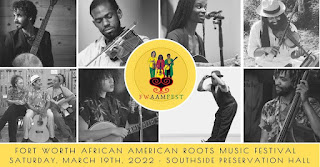
Fort Worth (TX) African American Roots Music Festival, 19 Mar. 2022

Thanks to Hearth Music PR for news of an epochal event in old-time and related music. The Fort Worth African American Roots Music Festival (FWAAMFest) will be held in the Southside Preservation Hall, Fort Worth, TX, from noon to 10 p.m. on Saturday 19 Mar. Organised by Brandi Waller-Pace, founder and executive director of the non-profit Decolonizing the Music Room organisation, FWAAMFest (also on Facebook) is the only major US city festival focused on old-time, jug band, string band, early blues, and jazz music that is black-led and showcases black performers. There are hopes that it will become a landmark event for the traditional music community.

More details are on the Hearth Music press release. An online FWAAMFest, held in March 2021, can be seen in a two-hour YouTube video; it was welcomed by fiddle-and-banjo-player Jake Blount on Oldtime Central (OTC). See also two earlier OTC articles, 'Creating a safer space in traditional music' by A'yen Tran (7 Nov. 2019) and 'Decolonizing the music (room)', an interview with Brandi Pace (31 Dec. 2019); and the Facebook group 'Traditional Music Today'.

© Richard Hawkins

Labels: , , ,

23 March 2021

New podcast series on black Appalachian music

The subject of black music in Appalachia is deservedly receiving greater attention, and the Great Smoky Mountains Association has accordingly launched a new mini-series, 'Sepia tones: exploring black Appalachian music' on its 'Smoky Mountain Air' podcast channel. To be broadcast every other month, the six episodes are hosted by two distinguished scholars, Dr William Turner and Dr Ted Olson.

The image shown above comes from the Association's Facebook, where there is a basic introduction and a link to the fuller details on the Association's website. See also John Lawless's feature on Bluegrass Today. The first episode can be heard here. The 33 minutes include five musical examples; one contributor is the English folksinger Martin Simpson, performing 'John Hardy' with Dom Flemons.

Listeners can expect to learn a lot, and not just about Appalachian music. It was revealed that though 1619 is widely regarded as the earliest date at which African slaves came to North America, Spanish explorers and their Moroccan slaves were in the Smokies "at least one hundred and fifty years before then" - that is, in 1469 or earlier. Which raises the interesting point: did anyone think of telling Columbus before he set out?

© Richard Hawkins

Labels: , , ,

02 February 2021

Mostly banjo

Yesterday (1 Feb.) Ken Perlman (USA), master of 'melodic clawhammer' banjo, began his programme of four online live instructional banjo workshops on Zoom, devoted to 'Translating the fiddle music of Cape Breton and Prince Edward Island to clawhammer banjo' and taking place every Monday this month. Details of times and prices are given on the booking pages.

The eight hour-long workshops which Ken has already given on different aspects of clawhammer technique and playing can be bought as videos for $25 each from his Clawhammer Clinic encore collection.
*
In his latest e-newsletter, Michael J. Miles (USA) as always shows his wide-ranging musical tastes; three videos include one of Bach's 'Sleepers awake' on banjo, and versions of 'Lean on me' and 'Both sides now' for fingerstyle guitar. Further information on Michael's one-off workshops for guitar and clawhammer banjo, as well as his four-week classes for both instruments and his concert dates, can be found here.
*
Deering Banjos announce that last week's hour-long masterclass from Jens Kruger can be seen here, and today (2 Feb.) a follow-up session of questions and answers on the class (which was on playing fast and clean, and on embellishments) will be held at the usual times of 6.00 p.m. ET (3.00 p.m. PT). Jens's next masterclass (on chord substitution for backup, and playing without a capo) will be two weeks from now.
*
Finally, the International Bluegrass Music Association and Pisgah Banjos of Asheville, NC, announce that a special banjo has been made to be raffled at $20.00 a ticket with the object of raising $20,000 for the IBMA's Arnold Shultz Fund, which was set up in 2020 to support activities increasing participation of people of colour in bluegrass music. Bill Monroe acknowledged the influence that Shultz's playing had on him in youth, and the IBMA release includes a useful list of links to sources on Shultz and his musical legacy. For more details on the banjo, see John Lawless's feature on Bluegrass Today.

NB: People outside the USA who want to buy a raffle ticket through the Pisgah website will find that it doesn't cater for overseas addresses. Thanks to Pisgah's Patrick David Sawyer, who advises:

Use the Pisgah Banjo address [82 Whitaker Road, Fairview, North Carolina 28730]. If you win we will contact you for your shipping address. Thanks for supporting the Arnold Shultz Fund!

Labels: , , , , , ,

11 January 2021

22nd Portland Old-Time Music Gathering online, 14-17 Jan. 2021

Thanks to the FOAOTMAD blog, news medium of the UK's national old-time music and dance association, for the news that the vibrant and influential old-time scene in Portland, Oregon, will be holding the 22nd Portland Old-Time Music Gathering as a free online event ('Quarantine Edition') this coming Thursday-to-Sunday, 14-17 Jan. The full programme is given here.

There's a very impressive lineup, of whom a few acts have performed in Ireland: the Foghorn Stringband, the Horsenecks, Evie Ladin, Annie Staninec and John Kael. The website announces:

There will be concerts, jams, hangouts, song swaps, workshops, a Crankie show, a square dance for 2 or more people, a kids’ open mic and kids’ show, and a panel discussion titled: 'An introduction to race and racism in old time music' featuring Jake Blount and Tatiana Hargreaves.

The panel discussion will be dealing with issues similar to those touched on by the BIB in various posts during the past autumn.

Labels: , , , ,

02 December 2020

Something good out of something bad

The assertion has been made that some tunes in old-time music should be 'cancelled' because of the words that have been set to them in the past, or other historical associations (see the BIB for 1 Oct.). The recent appearance of Hanging tree guitars, published by The Bitter Southerner online magazine in association with Music Maker Relief Foundation, seems relevant to this issue.

For fifty years North Carolinian Freeman Vines, 'an artist, a luthier, and a spiritual philosopher', has been using old timber from many sources, together with other materials, to build guitars. The title of the book refers to those he has made from the wood of trees that were used for lynchings. A video, 'Hanging tree guitars: the art of Freeman Vines', can be seen on YouTube. Full details of the book are on the website.

Labels: , , ,